Lights Out, Ledger Open
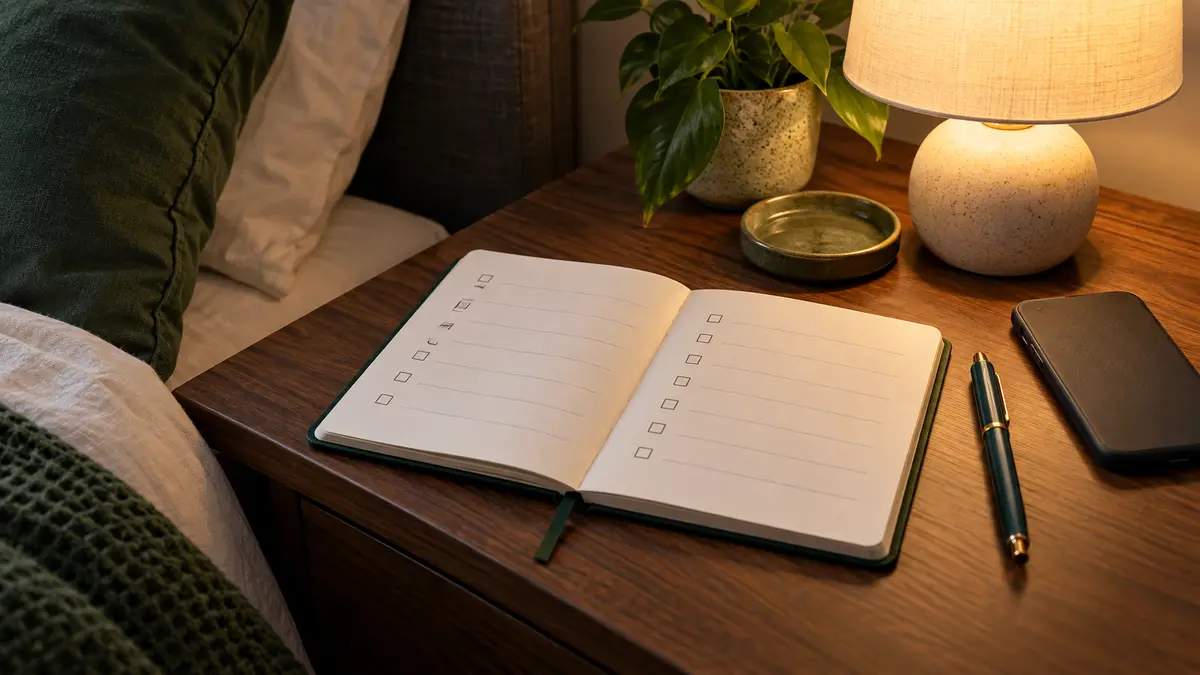
Eleven forty. Lights off, phone face down, the street finally quiet — everything the sleep advice tells you to do. Which is when your head calls a meeting: book the dentist, text your sister back, and by the way, why did you say that on the call?
You try lengthening the breath. Your head waits politely for the exhale, then picks up where it left off.
Warm shower, open ledger
Low light, no screens, a long shower: all reasonable, all aimed at the body, which was never the problem. What's still running is the list your head is guarding, and the moments you never put words to. And "just relax" turns rest into a task with no finish line — the only way to check whether it worked is to check, which switches you back on.
Your head is still on shift
Unfinished business sticks; finished business evaporates. The night before you had to move the car ahead of the street sweeper, you woke twice. The evening after you moved it, the car never crossed your mind.
The inventory keeps no sense of scale: "batteries for the remote" and "talk to Dad about selling the house" hang at the same weight, because neither is closed. Nobody has signed the log, so the night watchman stays on.
Under that sits a second layer — whatever went unnamed. Your manager's clipped reply. The pause in a conversation you've replayed three evenings running. Here the two part ways. A task needs an address outside you: paper, a calendar, somebody else's hands. A feeling needs no address. It needs a name. Until you've said "that embarrassed me," the episode keeps coming back looking for its wording.
Which lands somewhere unglamorous: in the evening, unloading beats calming down.
Boring is the point
Planning is stimulating — estimates, running order, an argument with yourself about what matters. An evening list is a different genre: not to speed up tomorrow, to end today. You can hear it in the wording.
- "finally deal with the report" — planning, and faintly threatening;
- "open the report file, write one paragraph" — a boundary, and pleasantly dull.
Dull is what you're after. Not momentum, a receipt: written down, held by the paper, no longer held by you.
Not everything open is a task
Late in a brain dump, things surface that no to-do list will take. The cringe at your own tone in a thread. The parcel you keep meaning to return is a task; the reason you keep not returning it isn't.
Write "process the resentment" and your head asks what step one looks like, then brings the question back at two in the morning. One move works here: name it, plain words, first person. Two things spoil it.
- Naming turns into a case. "I'm hurt because he always—" and because has opened a fresh meeting. The full stop goes earlier.
- It feels too small to write. Being interrupted hardly seems worth the ink. Write it anyway; it takes up the space either way.
Naming dissolves nothing. It just takes the thing off tonight's agenda, like a paid bill still in the drawer.
The practice: fifteen minutes at the edge of the day
What you need
Paper, a pen, a table — not the bed; let the bed keep one job. Forty minutes before you lie down, with a timer, so the evening doesn't become a project. A covered table? A windowsill and the back of a receipt will do.
The steps
1. Empty it out. Errands, promises, half-said things, "no idea where things stand with M." Don't sort as you go: sorting means judging, and judging wakes you up. If it dries up after a minute, sit there; a second wave usually arrives.
2. Mark the lines. T for task, D for a decision waiting on you, F for a feeling or anything that isn't a task.
3. Turn tasks into first moves. Three for tomorrow, maximum, each a physical action: not "sort out the bank," but "10 a.m., call the number on the card." The rest go under someday — paper holds them now.
4. Give decisions a date. "Whether to take the offer" isn't tomorrow's task. Write "thinking about this Saturday morning." A delay with a day on it goes down easier than one without.
5. Give feelings a sentence. One line each, and underneath, four words: not doing anything tonight.
6. Close the notebook with your hands. Into the drawer, rinse the mug, kill the kitchen light. Your head wants an outside sign the shift ended.
Something surfaces later anyway: dim light, one line in the notebook by the bed, back down. No phone. That isn't the ritual failing, that's the ritual.
What it does, and what it doesn't
Not falling asleep in five minutes; nobody can promise that. The sign is quieter, and not on night one: a thought arrives, you recognise it as written down with a first move attached, and it leaves without an argument. Look again around day five — at how often you argued with your own head, not at the clock. Twenty items on the list means going back to the rule of three.
Worth saying plainly: fifteen minutes with a notebook empties a list and names a feeling, and the causes stay where they were. If your sleep has been off for weeks and it's showing in your days, that's a conversation for a doctor, not a notebook.
About the author
Prepared by the Venera editorial team. About Venera
Comments
Log in to leave a comment.